Skip to content

Nomination history becomes particularly revealing when looking at publishers with most GOTY nominations, as recognition appears heavily concentrated among a limited number of companies.
By analyzing historical GOTY nomination data, it becomes clear that recognition is not evenly distributed across publishers. While many publishers appear sporadically, a very small group concentrates a disproportionate share of nominations over time.
This post presents a data-driven overview of which publishers have been nominated most frequently for Game of the Year, based strictly on nomination counts and without interpretative analysis.
The Dataset
The data presented in this post is part of a broader Game of the Year dataset developed as an independent research project focused on nomination history across multiple structural dimensions of the industry.
The dataset compiles official GOTY nominations over several years, organizing entries by publisher, development studio, platform association, release timing, and additional classification attributes. The publisher breakdown shown here represents one analytical layer within this larger dataset.
For this article, the focus is limited specifically to nomination frequency at the publishing level. Unlike studio-level analysis, publisher attribution reflects broader portfolio management, franchise ownership, and multi-studio oversight across console generations.
Other dimensions of the dataset, including studio concentration, platform distribution, and release timing patterns, are explored separately in dedicated posts.
The full dataset has been structured and visualized using Power BI, where interactive charts allow for deeper exploration of nomination distribution, recurring publisher presence, and long-term concentration patterns.
You can access the complete visualization here: Dashboard.
GOTY Nominations by Publisher (Original Chart)
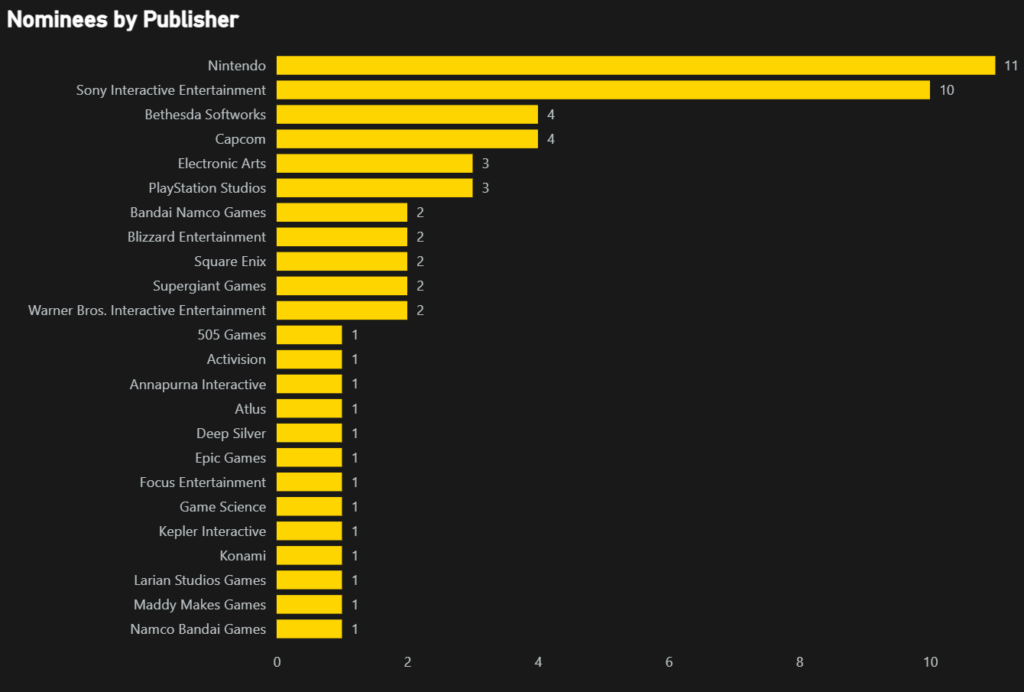
The chart above displays the number of GOTY nominees released by publishers.
Nintendo (11 nominations)
Nintendo operates not only as a development studio but also as a major first-party publisher, primarily releasing titles tied to its own hardware ecosystem. As a publisher, it oversees production, distribution, and global marketing for internally developed franchises and selected partner projects.
Its nomination presence in the dataset reflects long-term franchise continuity and consistent release cycles across multiple console generations.
It is the publisher with most frequently nominated publisher in the dataset, holding the top position with 11 total GOTY nominations.
This places Nintendo clearly ahead of all other publishers in terms of repeated nomination presence.
Sony Interactive Entertainment (10 nominations)

Sony Interactive Entertainment functions as the publishing division responsible for PlayStation platform releases. As a first-party publisher, it manages a portfolio of internally developed studios while also overseeing strategic partnerships and publishing agreements.
Within the dataset, its nomination frequency reflects sustained first-party output and recurring franchise visibility across successive PlayStation generations.
It ranks second with 10 total GOTY nominations, standing as the only publisher besides Nintendo to reach a comparable level of sustained nomination frequency.
The gap between Sony and the remainder of the field is still significant.
Publishers with 4 or fewer nominations
| 4 nominations | – Bethesda Softworks – Capcom |
| 3 nominations | – Electronic Arts – PlayStation Studios |
| 2 nominations | – Bandai Namco Games – Blizzard Entertainment – Square Enix – Supergiant Games – Warner Bros. Interactive Entertainment |
| 1 nominations | – 505 Games – Activision – Annapurna Interactive – Atlus – Deep Silver – Epic Games – Focus Entertainment – Game Science – Kepler Interactive – Konami – Larian Studios – Maddy Makes Games – Namco Bandai Games |
The prevalence of single-nomination publishers illustrates how rare repeated recognition is at the publishing level. Although many companies contribute to critically acclaimed titles, only a limited number maintain consistent nomination visibility over time.
The distribution therefore reflects structural concentration rather than broad parity across the industry.
Closing Notes
This overview documents the numerical distribution of GOTY nominations by publisher without extending into qualitative evaluation.
The data clearly indicates a strong concentration among a limited number of publishers, with Nintendo and Sony Interactive Entertainment occupying the top positions.
If you are curious about what actually is behind a Gaming Publisher I cover that in a separate breakdown: What Does a Gaming Publisher Do?