Skip to content

GOTY release timing is often overlooked in award discussions, yet it represents a measurable and consistent pattern within nomination history.
Game of the Year nominees span a wide range of genres, studios, and platforms. However, beyond creative differences, they also share a measurable characteristic: their release timing.
When analyzing GOTY nominees by month, patterns begin to emerge in how releases are distributed throughout the calendar year. Some months show a clear concentration of nominations, while others appear significantly less represented.
This post presents a structured breakdown of GOTY nominees by month, based strictly on release date data from the dataset. No assumptions are made about marketing strategy, award timing, or industry trends. The objective is to document how nomination frequency aligns with the calendar.
The Dataset
The data presented in this post is part of a broader Game of the Year dataset developed as an independent research project focused on nomination history and GOTY release timing patterns.
The dataset compiles nomination history across multiple years, organizing entries by release date, platform association, publisher classification, and other structural attributes. The monthly distribution shown above represents only one segment of the overall dataset and contributes specifically to the analysis of GOTY release timing.
For this article, the focus is limited specifically to release month frequency and how GOTY release timing aligns with the calendar year. Other dimensions of the dataset, including platform breakdowns, publisher classifications, and nomination patterns across generations, are explored in separate posts.
The full dataset has been structured and visualized using Power BI, where interactive charts allow for deeper exploration of nomination history and release timing trends.
You can access the complete visualization here: Dashboard.
Distribution of GOTY Nominees by Month
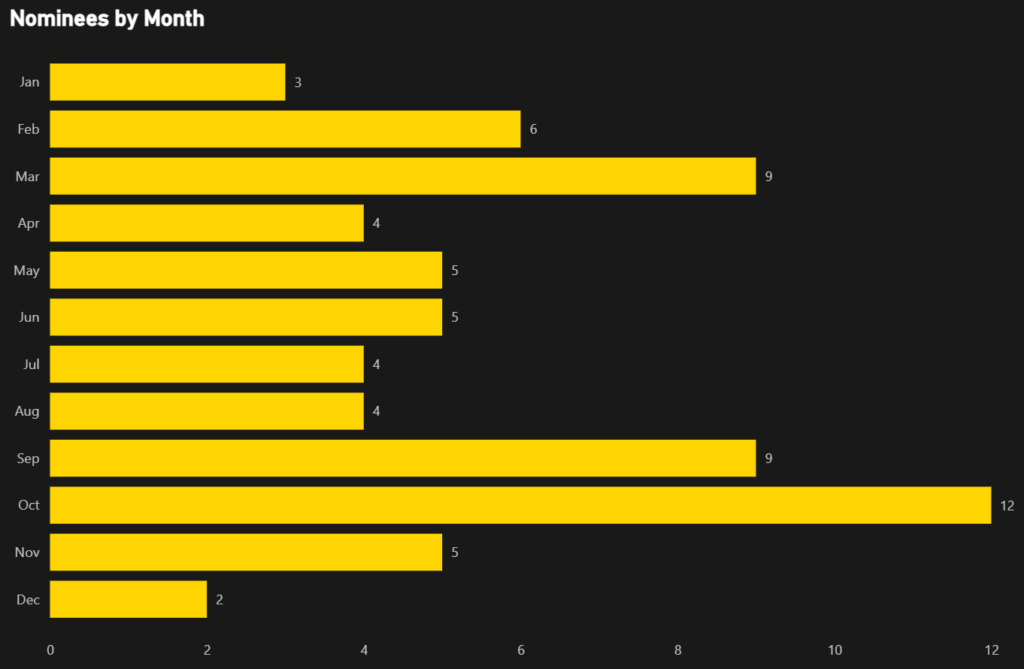
The chart above displays the number of GOTY nominees released in each month of the year.
A clear concentration appears around specific periods, while other months show significantly lower representation.
Key observations from the data
| Month | Nominees |
|---|---|
| January | 3 |
| February | 6 |
| March | 9 |
| April | 4 |
| May | 5 |
| June | 5 |
| July | 4 |
| August | 4 |
| September | 9 |
| October | 12 |
| November | 5 |
| December | 2 |
October leads the distribution with 12 nominated titles, standing noticeably above every other month.
March and September follow closely, each recording 9 nominations. These months form a secondary peak within the annual cycle.
February, May, June, and November form a middle tier, each containing between 5 and 6 nominations.
April, July, and August show moderate representation with 4 nominations each.
At the lower end of the distribution, January records 3 nominations, while December has the fewest, which was a it surprising for me to be honest, with 2. These months represent the least prominent periods in terms of recorded GOTY release timing.
Closing note
Across the dataset, a clear concentration emerges in specific parts of the calendar year, making GOTY release timing somewhat unpredictable.
October stands as the most represented month, followed by March and September, forming the highest-density periods in nomination history.
Mid-year months such as May, June, and November maintain moderate representation, while early-year and end-of-year months show noticeably lower counts.
January and December remain the least represented months in the dataset.
At first glance, one might expect late-year releases to dominate even more heavily, especially considering that Game of the Year awards typically take place near the end of the calendar cycle. Recency could reasonably be assumed to influence visibility. However, the dataset shows that while October is strongly represented, nomination distribution remains more varied than a purely “end-of-year effect” would suggest.
When grouped seasonally, the data indicates that nominations are not evenly distributed throughout the year. Instead, they cluster around select periods, while several months consistently record fewer releases among nominated titles.
It is important to note that this post does not attempt to explain why these patterns occur. No assumptions are made regarding marketing strategies, award deadlines, or industry scheduling practices. The objective is solely to document observable distribution within the dataset.
As mentioned earlier, this overview is limited to the observable data. The figures reflect release timing only, without extending into interpretation or broader industry conclusions.
Any discussion around why certain months dominate the nomination landscape is intentionally left out and addressed separately in analytical follow-up post.