Skip to content

Some genres seem to live at the center of the GOTY conversation every year, while others rarely appear in nomination history. Lets take a closer look to genres with most goty nominations by examining historical nomination data, patterns begin to emerge that go beyond individual titles and point toward broader structural preferences within the award landscape.
This post focuses strictly on numerical distribution to find out which are the game genres with most GOTY nominations, which ones appear less frequently, and how quickly representation declines after the top categories.
The Dataset
The data presented in this post is part of a broader Game of the Year dataset developed as an independent research project focused on nomination history across multiple structural dimensions of the industry.
The dataset compiles official GOTY nominations over several years, organizing entries by primary genre classification, publisher, development studio, platform association, and release timing. The genre breakdown shown here represents one analytical layer within this larger dataset.
For this article, the focus is limited specifically to nomination frequency by genre. Because many modern games blend multiple mechanics and design philosophies, each title has been assigned a single primary genre for consistency within the dataset.
Other dimensions of the dataset, including publisher concentration, studio recurrence, platform distribution, and release timing patterns, are explored separately in dedicated posts.
The full dataset has been structured and visualized using Power BI, where interactive charts allow for deeper exploration of nomination distribution, genre concentration, and long-tail representation patterns.
You can access the complete visualization here: Dashboard.
GOTY Nominations by Genre (Original Chart)
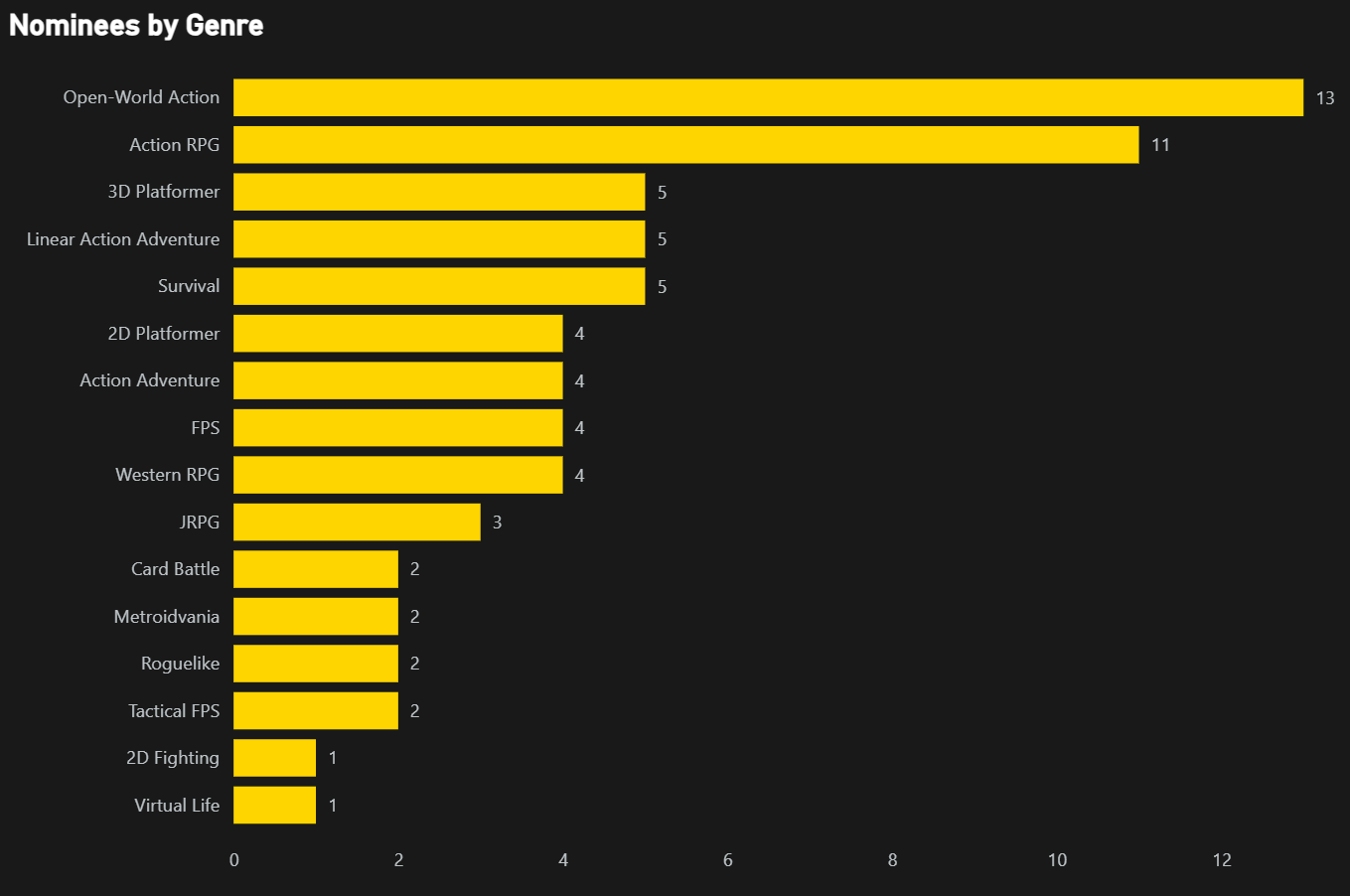
The chart above displays the number of GOTY nominees released by genres.
Open-World Action (13 nominations)
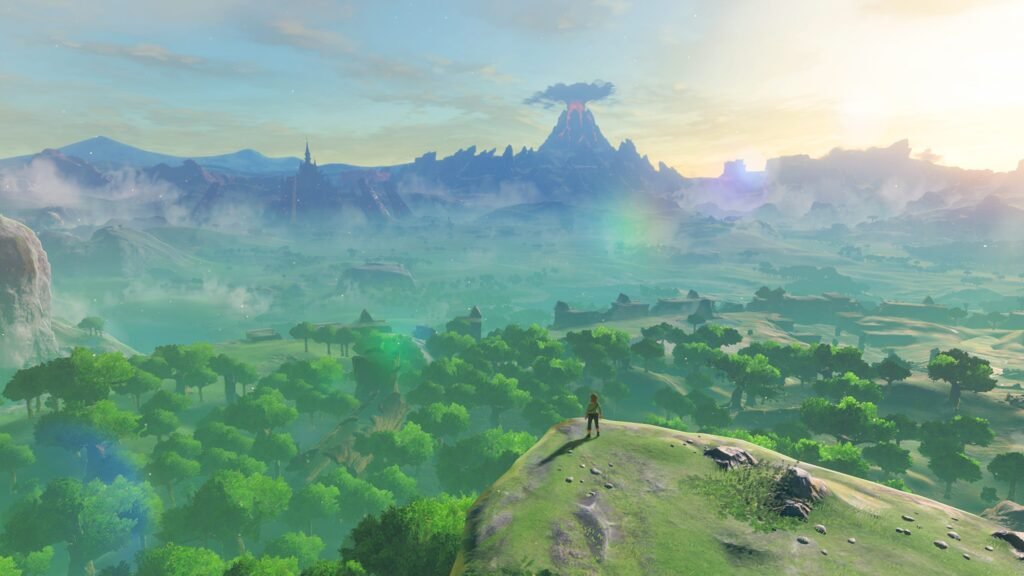
Open-World Action games are structured around large, navigable environments where players are free to explore and engage with objectives in a non-linear order. Combat, traversal, and environmental interaction are typically central to the gameplay loop. These titles often combine cinematic presentation with systemic world design, allowing player-driven progression within expansive maps.
It is the most frequently nominated genre in the dataset, with 13 GOTY nominations, standing clearly above all other categories. No other genre reaches the same level of nomination frequency, which places Open-World Action alone at the top.
This dominance is visible without the need for secondary metrics or interpretation and the separation is purely numerical.
Action RPG (11 nominations)

Action RPG titles blend real-time combat mechanics with role-playing progression systems. Character development, stat growth, equipment customization, and skill trees are integrated into a combat-focused structure. Unlike traditional turn-based RPGs, Action RPGs emphasize direct player input during encounters while maintaining layered progression systems.
It ranks just below Open-World Action, with 11 GOTY nominations, forming the second most frequently nominated genre in the dataset. While it does not surpass the top position, Action RPG remains clearly separated from the rest of the field, confirming its status as one of the two dominant genres in GOTY nominations.
The rest of the genres (additional context)
| Genres with 5 Nominations | – 3D Platformer – Linear Action Adventure – Survival |
| Genres with 4 Nominations | – 2D Platformer – Action Adventure – FPS – Western RPG |
| Genres with 3 Nominations | – JRPG |
| Genres with 2 Nominations | – Card Battle – Metroidvania – Roguelike – Tactical FPS |
| Genres with 1 Nominations | – 2D Fighting – Virtual Life |
Beyond Open-World Action and Action RPG, all other genres appear significantly less often among GOTY nominees.
While a small group clearly dominates nominations, the majority of genres form a long tail with limited representation. Each group in here were organised based on how many nominations the Genre has.
Closing Notes
This overview documents which genres dominate GOTY nominations strictly through numerical distribution.
The data shows a clear concentration at the top, followed by a rapid decline in representation across the remaining categories. Further analysis exploring why certain genres maintain stronger nomination visibility is addressed separately.
If you’re curious about the genres that never show up, I cover that in a separate breakdown: here.